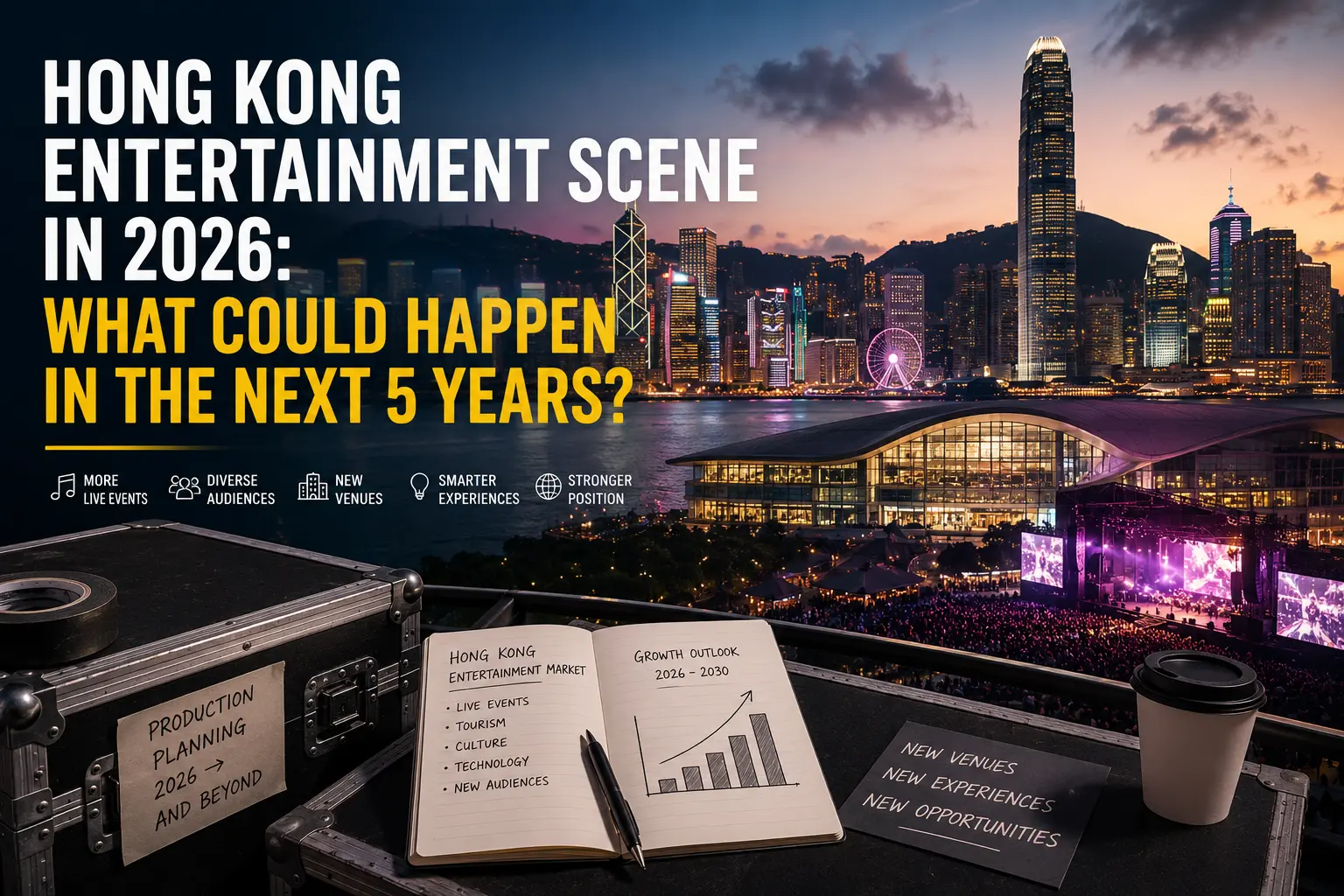
Hong Kong Entertainment Scene in 2026: What Could Happen in the Next 5 Years?
Hong Kong entertainment in 2026 feels like a city tuning its instruments before a bigger show.
The venues are changing. The audience mix is changing. The government is pushing mega events. Brands want experiences. Communities want culture. Artists want regional reach.
The opportunity is real.
But so is the competition.
Hong Kong has always had the ingredients: international access, strong transport, serious venues, corporate money, regional audiences, and a city culture that understands both East and West. Now, with Kai Tak Sports Park and a renewed push around mega events, the city is clearly trying to strengthen its role as an entertainment and event hub again.
The next five years will be interesting.
1. Hong Kong wants to be an event city again
Hong Kong Tourism Board describes the city as the "Events Capital of Asia" with world-class festivals and cultural celebrations throughout the year.
That positioning matters.
A city does not become an event hub only by having venues. It needs programming, tourism support, corporate participation, transport, hospitality, media attention, and repeated audience confidence.
BrandHK and HKTB have also been highlighting mega events, international conferences, exhibitions, arts, sports, and cultural activities as part of Hong Kong's city image.
This means events are not only entertainment. They are part of tourism, business, branding, and soft power.
2. Kai Tak Sports Park changes the top end of the market
Kai Tak Sports Park is a major shift.
The Main Stadium can accommodate up to 50,000 spectators. The complex also includes an indoor sports centre with 10,000 seats and other large event facilities.
For Hong Kong, this changes what is possible.
It creates a stronger home for:
But bigger venues also raise expectations.
When audiences experience better infrastructure, they become less forgiving of messy production, weak sound, poor crowd flow, unclear signage, and bad show timing.
Mega venues lift the market. They also lift the standard.
3. Creative industries are not a small side business
Hong Kong's Culture, Sports and Tourism Bureau reported that in 2023, creative industries had around 31,170 establishments and around 132,940 practitioners, with a combined added value of around HK$134.5 billion.
That is not small.
Entertainment, culture, production, design, film, music, advertising, digital entertainment, and related creative work form a real part of the economy.
For event organizers, this means the creative sector is not just about "nice ideas." It is a business environment with supply chains, professionals, venues, sponsors, freelancers, media, and audience behavior.
4. The middle market is where many opportunities live
Not every event is Coldplay, BLACKPINK, Art Basel, or a stadium sports event.
The middle market may be where many organizers can build real business.
This includes:
These events may not always make headlines, but they build relationships.
They are also more realistic for independent organizers, cultural groups, brands, and communities.
For support with event planning and production quality, KROMA works with organizers across this middle market.
5. Community-driven events will matter more
People do not only want entertainment. They want belonging.
That is especially true in a city like Hong Kong, where many communities live between cultures, languages, professions, and homes.
Indonesian, Filipino, South Asian, local Hong Kong, international student, church, music, and niche creative communities all have their own emotional worlds.
A good event can become a place where people feel seen.
This is why community events can be powerful even without giant budgets. If the audience feels the event belongs to them, they come back.
Check out Senandung Rindu / SENDU as an example of cultural events built around community.
6. Hybrid content will become normal
A modern event is no longer only a live moment.
It is also:
This changes how events should be planned.
If content matters, then lighting matters. Camera position matters. Audio feed matters. Stage layout matters. Backdrop matters. Timing matters.
An event that is not content-ready may miss half of its value.
7. The next 5 years: what to watch
8. What this means for event organizers
If you are planning an event in Hong Kong, start with these questions:
The best event plans are not only creative. They are operationally honest.
9. KROMA's angle
KROMA sits in the practical middle of this shift: planning, AV production, studio, content, and cultural events.
For clients, that means we can support both the event itself and the materials around it — from show-day technical support to livestream setup, studio preparation, and post-event content planning.
We believe the future of Hong Kong entertainment will reward teams who can combine creativity with structure.
The idea matters. But the execution decides whether people remember it well.