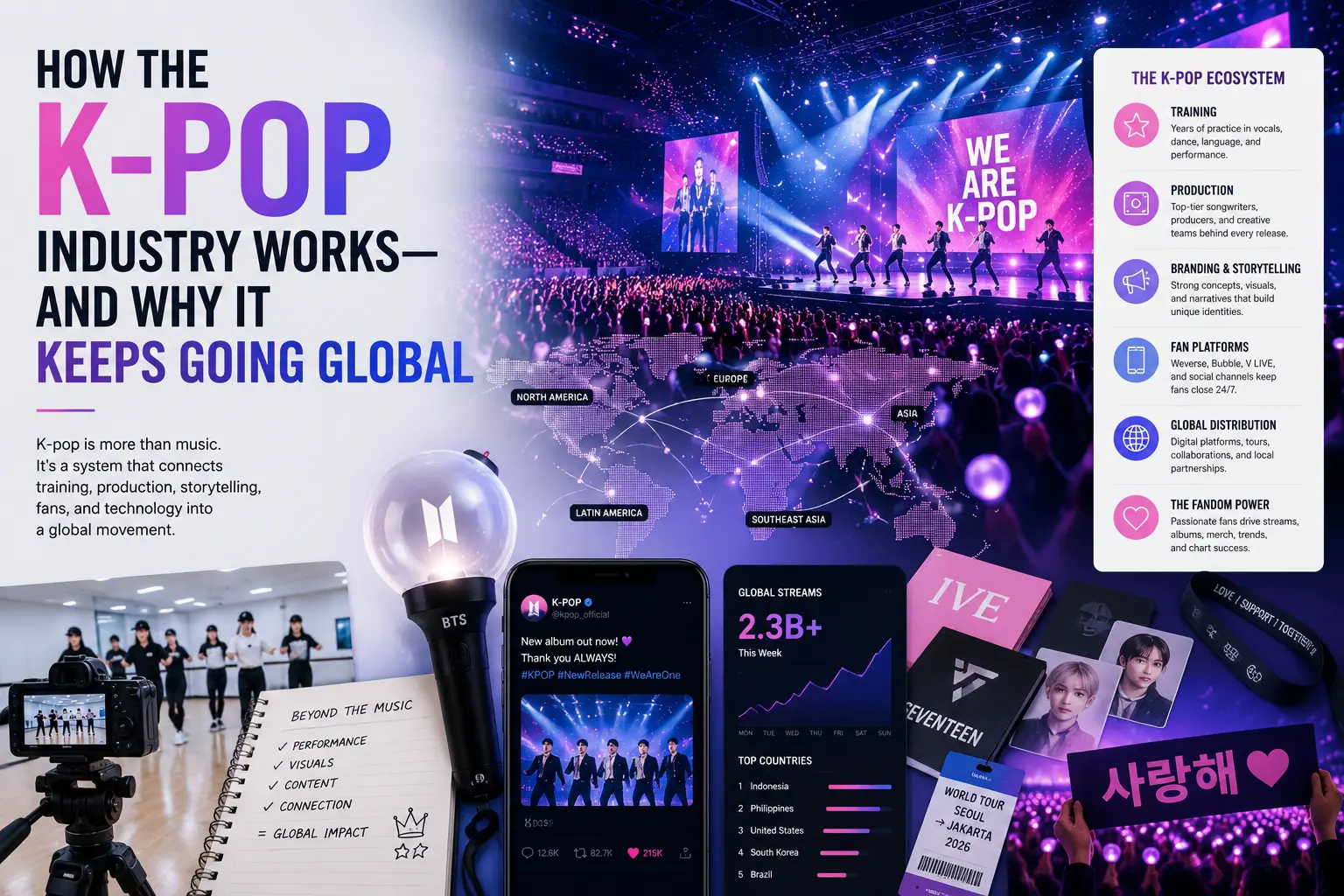
How the K-pop Industry Works — and Why It Keeps Going Global
K-pop did not become global by accident.
It is not only because the songs are catchy, the choreography is sharp, or the music videos look expensive.
Those things matter, of course. But the real engine is bigger.
K-pop is one of the clearest examples of music as a full entertainment ecosystem.
It is music, performance, content, fan community, touring, merchandise, visual identity, digital platforms, language strategy, and business planning all moving together.
That is why K-pop keeps travelling.
1. K-pop is not only music. It is an operating system.
A K-pop group is usually built around multiple layers:
This is why a K-pop comeback feels bigger than a normal single release.
It is not just "new song out now."
It is teaser photos, concept films, dance practice, music video, interviews, livestreams, fan sign events, choreography challenges, behind-the-scenes content, album versions, merch, and tour possibilities.
The song is the center. But the ecosystem around the song is what keeps attention alive.
2. The trainee system creates performance consistency
The K-pop trainee system is intense and not without criticism. But from a production perspective, it explains why the final product is so consistent.
Artists often train across:
This means idols are prepared not only to record songs, but to perform across many formats: concerts, TV shows, livestreams, interviews, fan events, brand shoots, and social content.
That consistency matters globally.
When a group travels to another country, they are not only bringing songs. They are bringing a complete performance package.
3. The fan economy is the real power source
K-pop fans do not only listen.
They participate.
They buy albums, stream songs, attend concerts, vote in music shows, translate content, create edits, organize fan projects, promote releases, buy merch, follow tours, and build communities.
In many ways, K-pop fans are not just the audience. They are the distribution network.
This is the genius of the model.
The label creates content, but the fandom multiplies it.
A good fandom can turn a music release into a global online moment.
4. Content never stops
Traditional music marketing often works like this:
Release song. Promote song. Wait for next song.
K-pop works differently.
Between major releases, there may be:
This keeps artists visible even when they are not actively releasing new music.
Visibility builds familiarity. Familiarity builds emotional investment. Emotional investment builds fandom.
This kind of consistent content strategy is something event organizers can apply too. Whether it is studio content or livestream setup, the principle is the same: stay visible between major moments.
5. The music is designed to travel
Modern K-pop often uses global-friendly tools:
This does not mean every K-pop song is designed the same way. But the industry understands that music now travels through clips, fandom edits, playlists, algorithms, and live performance moments.
A chorus is not only a chorus. It can become a dance challenge.
A music video is not only a video. It can become a visual universe.
A live stage is not only a performance. It can become hundreds of fan-shot clips.
6. Touring turns fandom into real-world economy
Streaming is powerful, but live events turn digital fandom into physical economy.
According to IFPI's Global Music Report 2026, global recorded music revenues reached US$31.7 billion in 2025, with streaming representing around 69.6% of recorded music income. Reuters also reported that paid streaming subscribers reached 837 million globally.
But K-pop is not only a streaming story.
Live performance is a major part of the business. Music Business Worldwide reported that HYBE generated record concert revenue of KRW 763.9 billion in FY2025, with 12 artists performing across 279 shows in 53 cities.
That is the ecosystem working.
The fan discovers the artist online. The fan watches content. The fan joins the community. The fan buys albums or merch. Then the fan attends the show.
The concert becomes more than a concert. It becomes proof of belonging.
7. K-pop is also a lesson for event organizers
Even if you are not building an idol group, the principles are useful.
- Build community before selling tickets
- Create content before and after the event
- Make the audience feel part of the story
- Use visual identity consistently
- Turn one event into a repeatable format
A weak event only asks people to attend.
A strong event gives people something to join.
8. The role of design, production, and discipline
K-pop proves that details matter.
Lighting matters. Sound matters. Styling matters. Camera blocking matters. Timing matters. Stage transitions matter. Fan communication matters.
Audiences may not describe those things technically, but they feel them.
When a show feels smooth, audiences trust it.
When a show feels messy, even a good artist can feel less professional.
That is why production is not just "equipment." Production is part of storytelling.
9. What KROMA learns from this model
At KROMA, we look at cultural events in a similar way.
A good event is not only stage, sound, and lights. It is audience, story, community, content, sponsor value, and the memory people carry after the show.
This matters especially for cultural events in Hong Kong, where communities are often looking for more than entertainment. They are looking for connection.
That is also why projects like Senandung Rindu / SENDU exist: to create cultural moments for Indonesian audiences in Hong Kong through music, nostalgia, and shared experience.