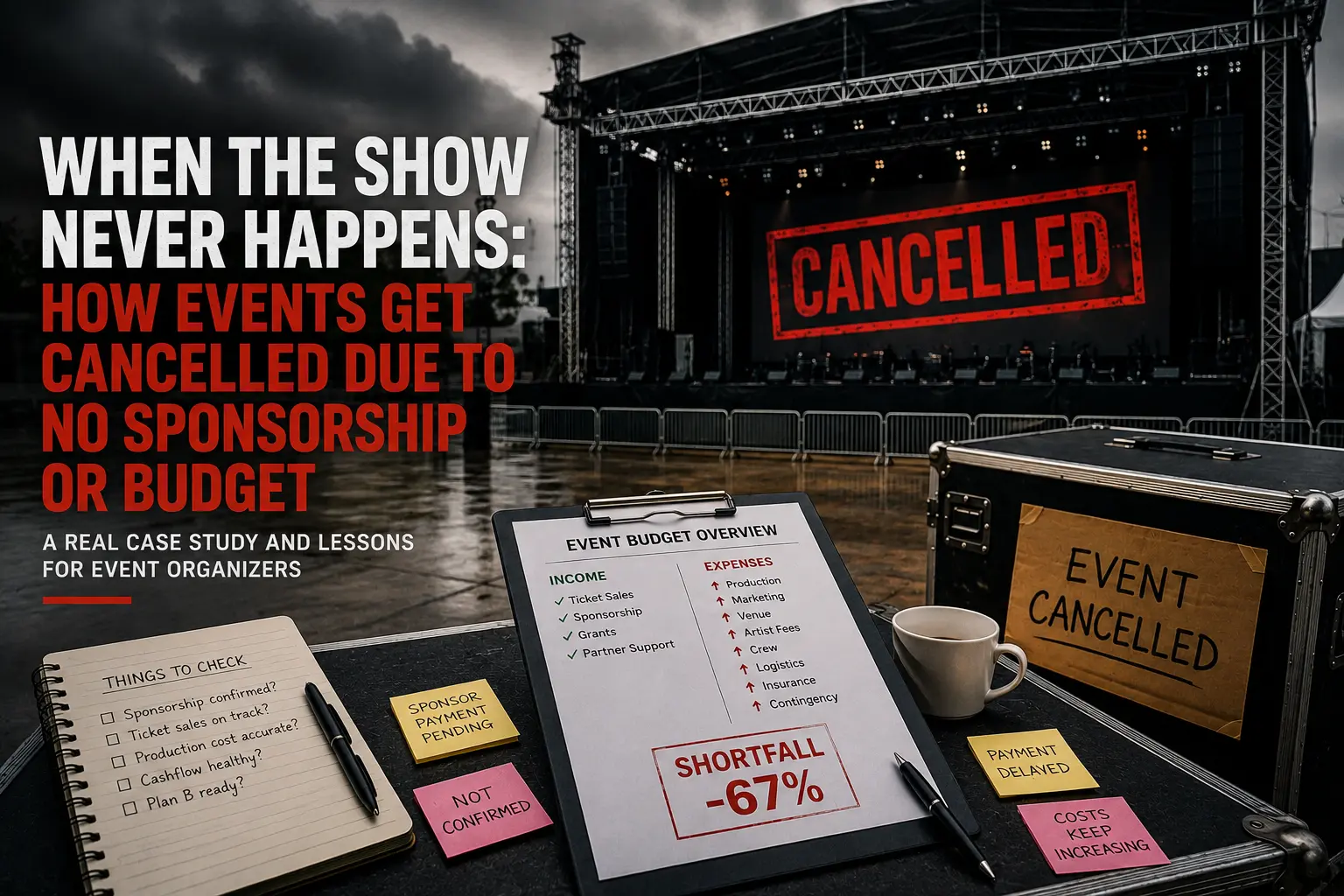
A good event budget is not just a spreadsheet.
It is the control room for your event.
It tells you what you can afford, what you should delay, what you need to cut, and when the event is becoming too risky. Without a proper budget, planning becomes vibes, optimism, and "we'll figure it out later."
That is dangerous.
A successful event does not only need a good idea. It needs a realistic financial structure behind the idea.
Whether you are planning a corporate event, concert, community gathering, cultural event, wedding, seminar, or brand activation, the budget should not be something you do at the end. It should guide the whole plan from the beginning.
1. Start with the event goal, not the shopping list
Many budgets go wrong because people start with things they want to buy.
Venue. Stage. Lights. Artist. Photographer. LED wall. Catering. Decorations. Livestream. Backdrop. Crew. More lights. Bigger stage. More everything.
But before listing expenses, ask:
What is this event supposed to achieve?
The goal changes the budget.
A product launch needs brand impact and guest experience.
A concert needs audience energy, sound quality, and ticket conversion.
A seminar needs comfort, timing, clarity, and smooth flow.
A cultural event needs community feeling, artist experience, and sponsor value.
A wedding needs emotion, flow, and reliability.
Once the goal is clear, you can decide which costs are essential and which costs are "nice to have."
Budgeting is not about being cheap. It is about spending in the right order.
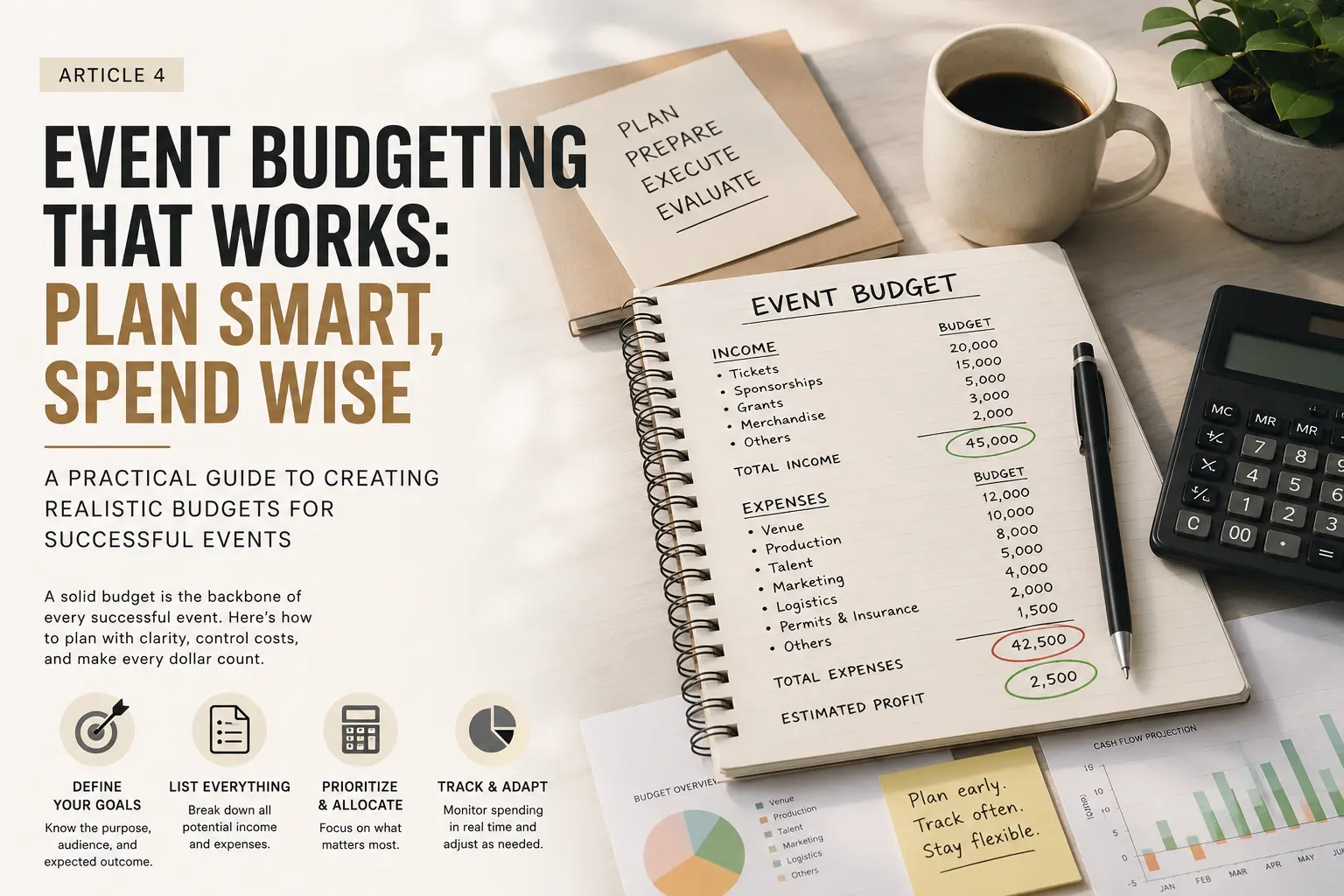
2. Build your budget around income and expenses
Every event budget needs two sides:
Income and expenses.
Income may include:
Expenses may include:
The mistake is treating expected income like confirmed income.
A sponsor who is "interested" is not confirmed.
A friend who says "I'll come" is not ticket revenue.
A viral post is not cashflow.
A grant application is not money until approved.
For safer planning, split income into two columns:
| Confirmed Income | Expected Income |
|---|---|
| Paid ticket sales | Social media interest |
| Signed sponsorship with payment date | Verbal sponsor interest |
| Approved grant | Pending grant application |
| Confirmed partner contribution | "People said they will come" |
That separation alone can save an event from bad decisions.
3. Know your fixed costs and variable costs
Not all costs behave the same way.
Fixed costs stay mostly the same whether 100 or 300 people come.
Examples:
Variable costs change depending on attendance or scale.
Examples:
This matters because your risk changes depending on which costs are fixed.
If your fixed costs are too high, you need strong income confidence before announcing the event.
If your variable costs are flexible, you have more room to adjust later.
4. Production budget is where details matter
Production is often underestimated because clients see the final show, not the preparation behind it.
A "simple sound system" may still involve:
Lighting may involve:
Livestream may involve:
This is why event organizers should ask for production estimates early, not after everything else is already confirmed.
A strong event budget does not treat production as leftover money.
Production is part of the experience.
5. Create a simple event budget table
Start with a table like this:
| Category | Estimated Cost | Confirmed Cost | Paid | Notes |
|---|---|---|---|---|
| Venue | Deposit deadline | |||
| Production | Audio, lighting, AV | |||
| Talent / Speaker | Payment terms | |||
| Marketing | Ads, design, printing | |||
| Crew | Setup, show, load-out | |||
| Logistics | Transport, storage | |||
| Insurance / Permit | If required | |||
| Catering | Per pax | |||
| Contingency | Keep untouched |
This does not need to be complicated at first.
The important thing is that you track three numbers:
Estimated cost: what you expect
Confirmed cost: what suppliers quoted
Actual cost: what you really paid
If you only track estimates, the budget will lie to you.
6. Add contingency before things go wrong
Contingency is not spare money.
It is event insurance for reality.
Things can change:
Budget warning
If the event only works when every optimistic assumption happens, the event is not ready yet.
A practical starting point is usually 10–20% for events with higher complexity, or 5–10% for simpler and more familiar events.
The exact number depends on the risk.
If the event is new, technical, outdoor, high-profile, or sponsor-heavy, keep more contingency.
If the event is repeatable, indoor, familiar, and simple, you may need less.
But do not start with zero. Zero contingency means one surprise can become a crisis.
7. Track cashflow, not only total budget
An event can be profitable on paper and still run into cashflow problems.
Why?
Because payment timing matters.
You may need to pay deposits before ticket sales arrive. You may need to confirm suppliers before sponsor money is transferred. You may need to pay artists before the event but receive final partner payment after the event.
So your budget should include payment timing:
Cashflow is the part of budgeting that feels boring until it becomes urgent.
Track it early.
8. Decide what can be cut before you need to cut it
A strong budget has priorities.
Before costs become stressful, decide:
What to protect first
Protect the parts that affect safety, audience experience, technical reliability, and event flow before spending on decoration, extras, or visual upgrades.
Must-have:
Should-have:
Nice-to-have:
This makes decision-making easier.
If the budget gets tight, you already know what to protect and what to reduce.
The worst time to decide priorities is during panic.
9. Budget warning signs
Watch out if you see these:
If three or more of these are true, pause and review the event plan.
10. KROMA's practical approach
At KROMA, we prefer honest budgets.
That does not mean cutting everything. It means understanding what matters most for the audience experience and spending there first.
For some events, the priority is sound clarity.
For others, it is guest flow.
For some, it is livestream quality.
For others, it is sponsor visibility, artist comfort, or stage impact.
A good budget should support the event goal.
Not every event needs the biggest setup. But every event needs a setup that makes sense.
Need help shaping your event budget?
KROMA Works can help you turn the event idea into a realistic plan, production estimate, and show-day setup.