Good event audio is invisible when it works.
The audience hears the speech clearly. The singer feels supported. The video playback is at the right level. The host does not fight feedback. The livestream audio makes sense. Nobody talks about the sound system.
That is usually the goal.
But when audio goes wrong, everyone notices immediately.
The microphone squeals. The vocal disappears. The keynote speaker sounds like they are talking inside a cardboard box. The music is too loud at the front and too weak at the back. The livestream sounds nothing like the room. Suddenly, the event feels less professional even if everything else looks beautiful.
In Hong Kong, this can be extra challenging because many events happen in hotels, restaurants, function rooms, school halls, church spaces, shopping malls, industrial venues, outdoor public areas, and multi-purpose rooms. Not every venue is designed for clean live sound.
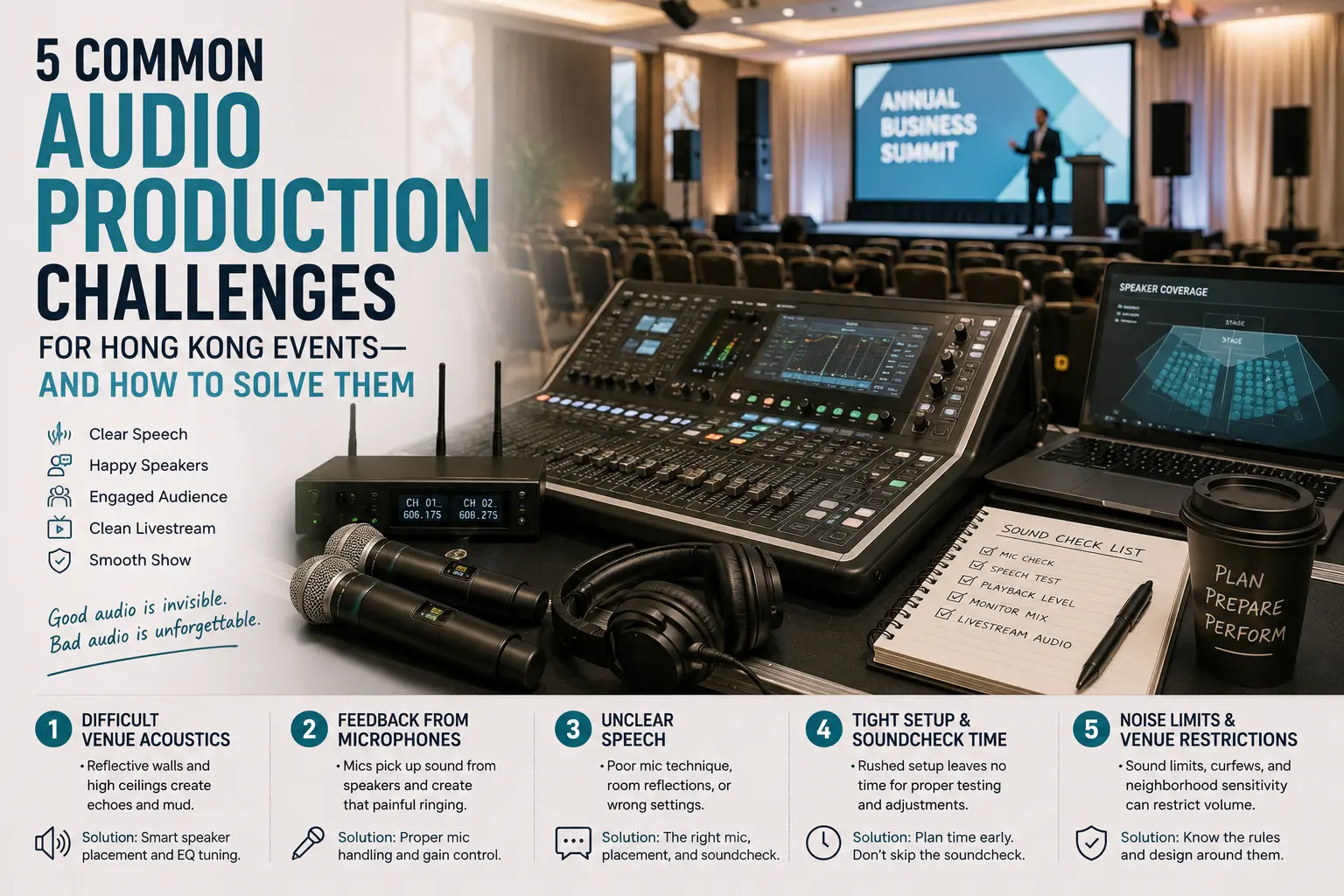
Here are five common audio production challenges we see in Hong Kong events — and how organizers can solve them before they become show-day problems.
1. Difficult venue acoustics
Some venues look great but sound difficult.
Glass walls, marble floors, concrete surfaces, high ceilings, hard walls, and odd room shapes can create reflections. That means sound bounces around the room instead of staying clear and direct.
The result?
Speech becomes muddy. Music feels harsh. The host sounds far away. People near the speakers may feel it is too loud, while people at the back still struggle to hear.
This is common in:
The mistake is thinking a bigger sound system automatically fixes the room.
It usually does not.
If the room is reflective, making the PA louder may only make the reflections louder.
How to solve it
Start with speaker placement and coverage.
The goal is to aim sound at the audience, not at every hard surface in the room. Depending on the venue, that may mean:
For speech-heavy events, clarity should come before power.
A clean, well-placed PA system will usually beat a louder but badly placed system.
2. Feedback from microphones
Feedback is the classic event nightmare.
It usually happens when a microphone picks up sound from a speaker, sends it back through the system, and creates a loop. That loop becomes the painful ringing sound everyone knows.
Feedback can happen with:
Lavalier microphones are especially tricky. They are convenient and look clean on camera, but they sit farther from the speaker's mouth and often need more gain. More gain means more feedback risk.
How to solve it
Good feedback control starts with the physical setup.
Useful steps include:
The last point is important.
If five panel microphones are open at the same time, the system becomes much more sensitive to feedback and room noise. A good operator should actively manage microphones during the program.
3. Unclear speech
For many corporate events, seminars, ceremonies, and community programs, speech clarity is more important than music quality.
If the audience cannot understand the speaker, the event fails at its most basic job.
Speech can become unclear because of:
In Hong Kong, another common issue is multilingual events. A program may include English, Cantonese, Mandarin, Bahasa Indonesia, or other languages. When speech clarity is poor, language switching becomes even harder for the audience to follow.
How to solve it
Treat speech as its own production requirement, not an afterthought.
For speech events, prepare:
Production tip
Do not test microphones by tapping them. Test with real speaking volume, because clarity and feedback risk only show up properly when the microphone is used like it will be used during the event.
A useful rule:
Do not test speech microphones by tapping them.
Test them with real speaking.
A mic tap only tells you the microphone is on. It does not tell you whether the voice is clear.
4. Tight setup and soundcheck schedules
Many audio problems are not caused by bad equipment. They are caused by not having enough time.
Hong Kong events often run on tight venue schedules. Load-in may be limited. Hotels may only release the room after another booking. Corporate events may have rehearsals, decoration, registration, catering, and technical setup all happening in the same short window.
When setup time is squeezed, the audio team may not have enough time to:
Then the event starts, and everyone wonders why the sound feels rushed.
Because it was.
How to solve it
Audio needs time in the event schedule.
Before show day, confirm:
For more complex events, soundcheck should not be treated as optional.
If there are singers, bands, multiple presenters, video playback, livestream, interpreters, or panel discussions, build proper technical rehearsal time into the schedule.
A smooth show usually comes from boring preparation.
Boring is good. Boring means fewer surprises.
5. Noise limits and venue restrictions
Some events cannot simply "turn it up."
In Hong Kong, noise can be a practical and legal consideration, especially for outdoor events, public venues, residential-adjacent venues, and government-managed spaces. For example, LCSD's guidance for amphitheatre activities notes that noise emission from such activities is governed by the Noise Control Ordinance, and daytime/evening noise measured at affected noise-sensitive receivers should not exceed 10 dB(A) above prevailing background noise in that context. The exact requirement depends on venue and event type, so organizers should always check the relevant venue rules and permit conditions.
Even when the issue is not legal, venues may still impose their own restrictions.
Common restrictions include:
If the audio plan ignores these rules, the event may face complaints, forced volume reduction, or last-minute changes.
How to solve it
Ask about sound restrictions early.
Do not wait until soundcheck.
Before confirming the production plan, ask the venue:
Then design the system accordingly.
Sometimes the answer is not more speakers. It may be better speaker direction, distributed sound, lower stage volume, better monitoring, or a different program layout.
Quick checklist for better event audio
Before the event, prepare:
| Problem | Common cause | Practical fix |
|---|---|---|
| Muddy speech | Reflective venue or poor EQ | Better speaker placement, real speech test, EQ adjustment |
| Feedback | Mic too close to speakers or too much gain | Reposition speakers, manage gain, mute unused mics |
| Uneven coverage | Wrong speaker position or venue shape | Aim speakers properly, add delay speakers if needed |
| Rushed soundcheck | Tight venue schedule | Confirm load-in and technical rehearsal time early |
| Volume complaints | Venue or neighborhood restrictions | Check sound limits and design system accordingly |
Audio planning checklist
- Venue floor plan
- Audience size
- Program rundown
- Microphone count
- Playback requirements
- Livestream requirements
- Stage layout
- Power location
- Setup time
- Soundcheck time
- Noise restrictions
- Backup microphone plan
KROMA note: audio is not only equipment
A common client question is:
"What speakers do we need?"
That is a fair question, but it is not the first question.
The better questions are:
Once those are clear, choosing the equipment becomes much easier.
At KROMA, we approach audio as part of the whole event experience. The sound system, microphones, operator, room, program flow, and schedule all need to work together.
Need clearer sound for your event?
KROMA Production helps plan and operate audio systems for corporate events, concerts, community programs, livestreams, and cultural events in Hong Kong.