Line Array, Point Source, or Column Array: Which Sound System Is Right for Your Event?
People love asking for line array.
It sounds premium. It looks serious. It makes the event feel like a concert before anyone has heard a single note.
But here is the thing: the best speaker system is not the most expensive one. It is the one that covers the audience properly.
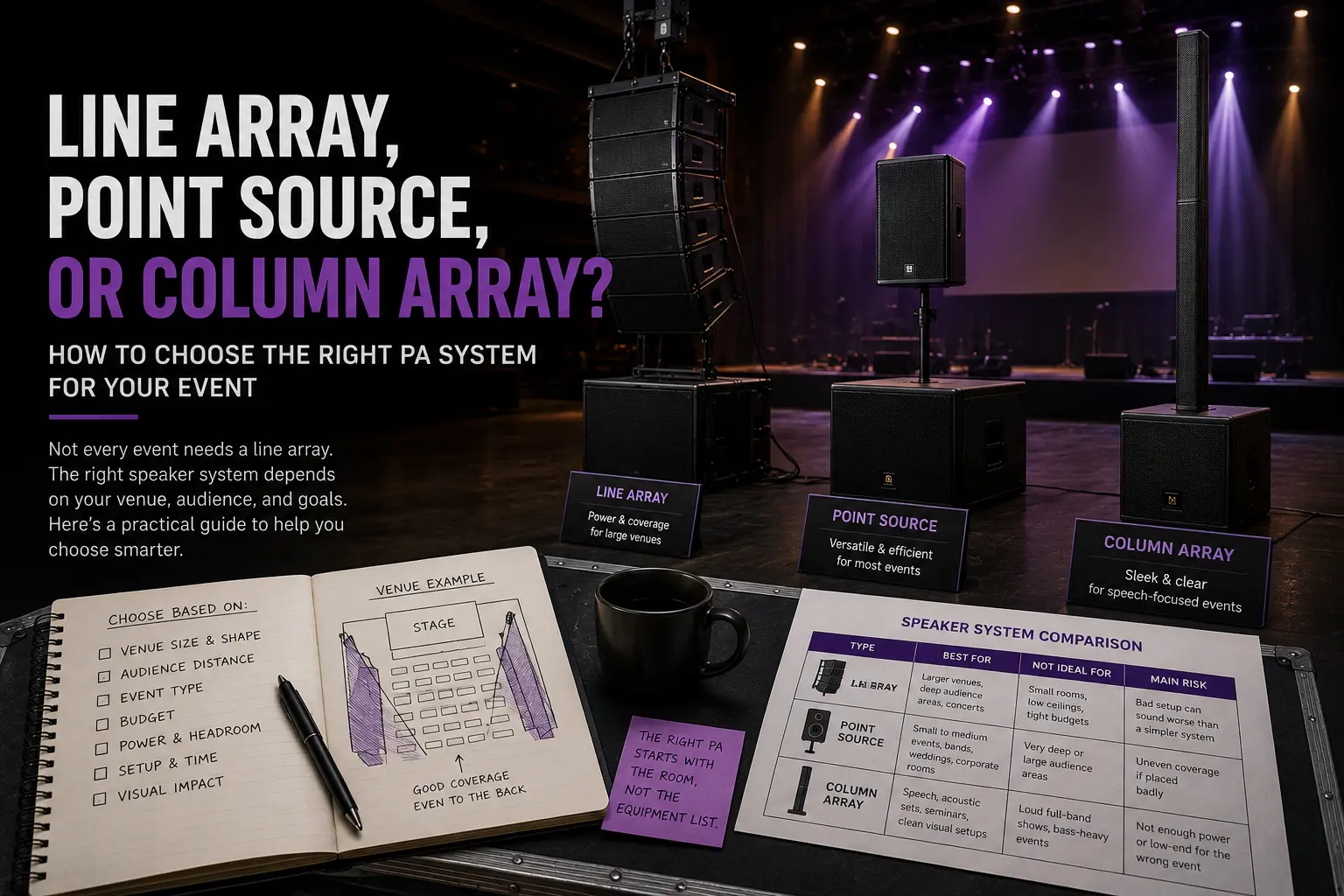
For some events, line array is the right answer. For other events, a good point source system will sound better, cost less, and set up faster. For smaller speech-led events, a column array may be cleaner and more practical.
Audio is not about speaker flex. Audio is about coverage, clarity, control, and context.
1. First: what problem are speakers solving?
The job of a speaker system is not simply to "make it loud."
A proper PA system should:
A good system should make the audience forget about the speakers. They should just hear the message, feel the music, and enjoy the event.
If people at the front are getting blasted while people at the back cannot hear clearly, the system is not doing its job.
2. What is a point source speaker?
A point source speaker is usually what most people imagine when they think of a PA speaker: one main speaker box projecting sound from one location.
Common examples include powered speakers on stands or larger passive cabinets flown or stacked near the stage.
Point source systems are often great for:
Why point source can be great
Point source speakers are simple, flexible, and cost-effective. When placed correctly, they can sound punchy, direct, and musical.
For many Hong Kong events, especially indoor events in hotels, function rooms, schools, studios, churches, and small venues, point source is often the cleanest starting point.
Where point source can struggle
Point source systems can become uneven in larger or deeper audience areas. People close to the speaker may hear too much, while people far away may hear too little.
If multiple point source speakers are placed badly, they can also interfere with each other, creating strange dead spots or harsh areas.
So point source is not "basic." It still needs proper placement.
3. What is a line array?
A line array uses multiple speaker elements arranged vertically. The goal is to control how sound spreads, especially vertically, so the system can throw sound further and cover larger audiences more evenly.
Line arrays are common in:
Why line array is powerful
A properly designed line array can help control coverage over distance. It can keep the front rows comfortable while still reaching the back rows.
It also looks professional, which is one reason clients often request it.
But the visual is not the point. The point is coverage.
When line array is not the answer
Line array needs proper design, rigging, tuning, and space.
It is not always suitable for:
A badly deployed line array can sound worse than a correctly placed point source system.
That sentence is worth repeating: expensive speakers do not fix poor system design.
4. What is a column array?
Column arrays are slim vertical speaker systems. They are often used when the event needs clean visuals, good speech coverage, portability, and a smaller footprint.
They are common for:
Why column arrays are useful
Column systems can look elegant and discreet. They are often fast to set up and can provide good speech clarity for the right room.
For events where the PA should not visually dominate the stage, column arrays can be a very practical choice.
Where column arrays struggle
Column arrays are usually not the best choice for loud full-band shows, heavy DJ events, or large noisy spaces unless supported properly with subwoofers and additional system design.
They can be excellent for clarity, but they are not magic sticks.
5. Speaker comparison table
| Speaker type | Best for | Not ideal for | Main risk |
|---|---|---|---|
| Line array | Larger venues, deep audience areas, concerts | Small rooms, low ceilings, tight budgets | Bad setup can sound worse than a simpler system |
| Point source | Small to medium events, bands, weddings, corporate rooms | Very deep or large audience areas | Uneven coverage if placed badly |
| Column array | Speech, acoustic sets, seminars, clean visual setups | Loud full-band shows, bass-heavy events | Not enough power or low-end for the wrong event |
If the room is small, start with placement. If the room is deep, think about throw. If the event is speech-heavy, prioritize clarity. If the event is music-heavy, prioritize headroom and low-end support.
6. The real question: audience layout
A 100-person narrow deep room is different from a 100-person wide shallow room.
The number of people matters, but the shape of the room matters more.
Before choosing speakers, look at:
Two events with the same audience count may need totally different audio systems.
This is why "How many pax?" is not enough. A good audio plan needs the room.
7. What KROMA looks at before recommending a system
At KROMA, we do not recommend line array just because it looks expensive.
We look at:
Sometimes the answer is a compact point source system. Sometimes it is line array. Sometimes it is a clean column setup with a subwoofer.
The right system is the one that makes people hear clearly without thinking about the speakers.
Need help choosing the right PA? Explore KROMA Production or see our services.